Reltio alternatives that don't cost $5,000 a month
An honest field guide to MDM tools when your company can't justify a Reltio license. Covers DIY, the open-source middle, and the SaaS landscape — with realistic price ranges.
The first time I priced Reltio for a project I was on, the number was $5,400 a month for the smallest production tier. The customer-data-mess I needed to fix didn't have $65,000 a year of business value attached to it. It had maybe $20,000 a year — enough that nobody wanted to live with it, not enough that finance would sign a Reltio PO.
That gap — "the problem is real, the budget isn't there" — is where most mid-market MDM projects die. They die quietly. People keep using the broken thing, run their bad reports, and complain about it in retros. The MDM-tooling category has been structured around enterprise buyers for so long that there's almost no honest middle.
This is a field guide for the buyer in that gap. I've personally evaluated or used most of these tools; the rest I've reverse-engineered pricing on through customer conversations and public posts. If you see a number that looks wrong for your actual quote, the spread is real — enterprise deals are negotiable and ranges drift with tier and add-ons.
What you're actually paying Reltio for
Before talking alternatives, it's worth being honest about what the $5k-$15k/mo Reltio price actually buys. It's not the matching algorithm. The matching algorithm is well-understood computer science from the 1990s — blocking, probabilistic scoring, transitive closure. That part is genuinely the easy part.
What you pay for is the operating surface around the engine:
- Survivorship rules. Field-by-field "who wins" when two records merge — most-recent timestamp, most-complete value, source priority.
- Lineage. Every golden record traceable back to the source rows that produced it.
- Audit chain. Tamper-evident logs for compliance.
- Review workflows. Steward UI for ambiguous matches — approve, split, merge.
- Connectors. Out-of-the-box ingestion for Salesforce, SAP, Workday, etc.
- Multi-tenant org structure. Permissions, scoping, environments.
- SOC2 / GDPR / HIPAA controls. Whatever regulators care about.
- A PS team. Reltio doesn't expect you to deploy this yourself.
The reason Reltio is expensive is that they package all of this and force you to take the bundle. If your dataset is 100k customer records and your team is one data engineer plus one analyst, you do not need the bundle. You need maybe 30% of the bundle, and you need it to cost less than your laptop refresh budget.
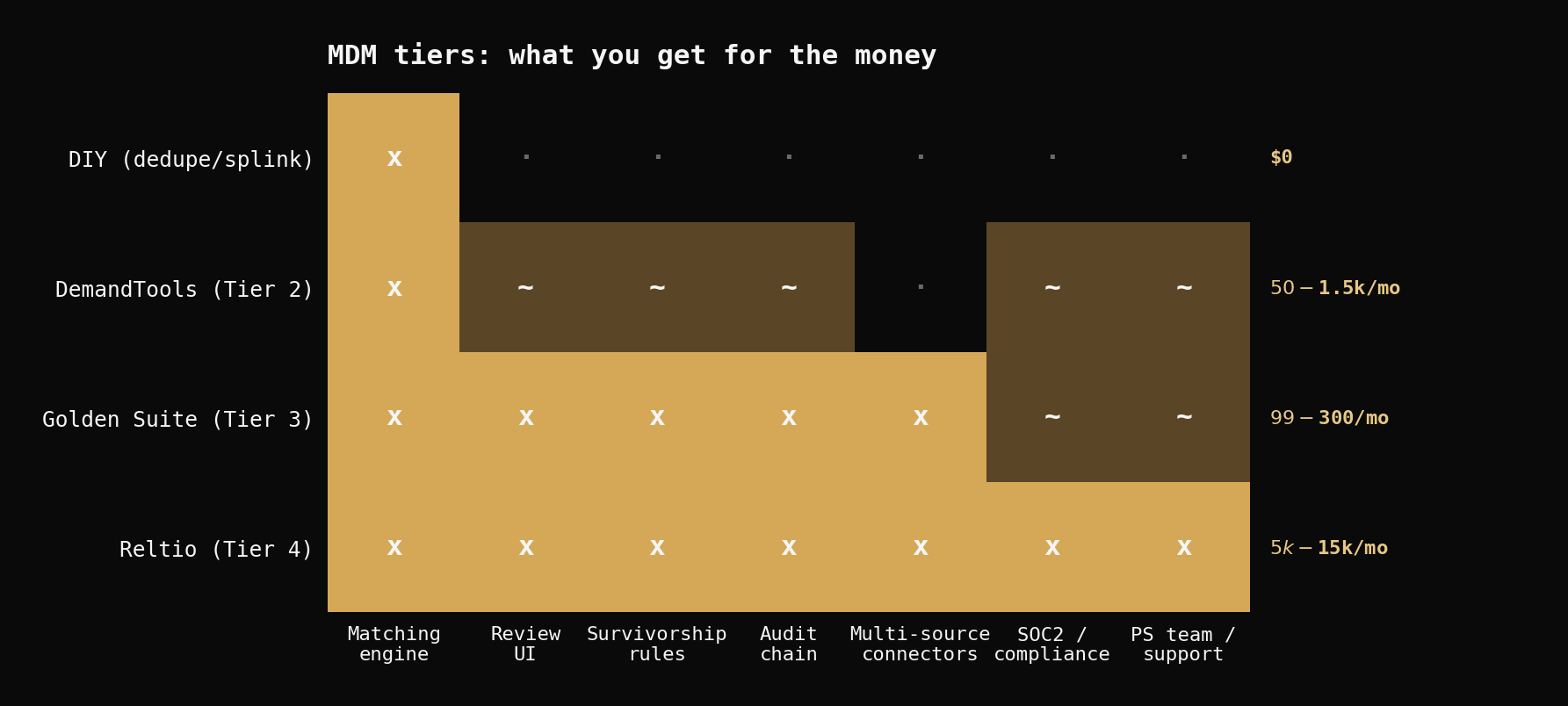
The four tiers of alternatives
The market is best understood as four tiers, ordered from cheapest to most enterprise:
Tier 1: DIY with open-source dedup libraries
Tools: dedupe (Python, by dedupe.io), splink (UK Ministry of Justice), recordlinkage (the academic library).
Cost: $0 in license, ~3-6 person-months of engineering time to get to "we actually use this in production."
What you get: the matching algorithm. That's it. You build the rest yourself — ingestion, survivorship, audit, review UI, scheduling, monitoring.
When this wins: You have a one-shot dedup project (vendor list cleanup before an acquisition close, for example) and a strong Python engineer with time to burn. The output is a CSV with a cluster_id column. You merge in Excel. You're done.
When this fails: You need the deduplication to be ongoing — every week new records flow in from your CRM, your billing system updates customer addresses, your support tool creates new contacts. Now you need a pipeline. Now you need monitoring. Now you need someone to review the ambiguous merges. The DIY path silently transforms from "an afternoon with dedupe" to "we are now the MDM team."
This is the most common failure mode I see. The DIY project ships, works for 3 months, then degrades as data drifts. Year 2 your lone data engineer leaves and the institutional knowledge of "why does that scorer return weird matches on Tuesdays" goes with them.
Tier 2: Sub-$1k/mo point tools
Tools: Salesforce-specific dedup tools like DemandTools ($1.2k/user/year) and Cloudingo (similar). HubSpot dedup add-ons. List-hygiene services like ZeroBounce or NeverBounce for email-level dedup.
Cost: $50-$1500/mo depending on user count and data volume.
What you get: Point solutions for one system. Salesforce-only, HubSpot-only, email-list-only.
When this wins: Your data quality problem is fully contained in one system. You don't have a customer-360 problem; you have a "duplicate accounts in Salesforce" problem. DemandTools is genuinely good at exactly that. If duplicates only exist in one place, don't buy MDM.
When this fails: Your customer records span 3+ systems. DemandTools cannot dedupe across Salesforce and HubSpot and Stripe and your warehouse. That's by design — it's a Salesforce tool. Once your problem is cross-system, point tools stop being the answer.
Tier 3: The open-source middle ($0-$300/mo)
Tools: Golden Suite (mine, $99/mo Pro), self-hosted Singer/Meltano + dedupe.py, hosted versions of splink if you can find one.
Cost: $0 self-hosted, $99-$300/mo for the hosted path with the operating surface included.
What you get: The matching engine plus the operating surface — review UI, lineage, audit, survivorship, multi-source connectors — packaged so you don't have to build it.
When this wins: You're somewhere between "DIY is overwhelming us" and "Reltio is overpriced for us." You have 50k-2M customer records, 3-6 source systems, one data engineer plus an analytics-engineer-shaped person, and a clear quarterly business case (lift conversion / fix attribution / pass an audit).
When this fails: You're at the scale where Reltio's PS team is a feature, not a bug. If you have 50M customer records, real-time match SLAs, regulated workloads requiring a BAA, and a procurement team that requires SOC2 Type II + ISO 27001 + a vendor risk questionnaire that takes 8 weeks to fill out — this tier is genuinely too lean for you. The next tier exists for a reason.
I'll be upfront about my bias here: Golden Suite is my product, and this tier is where I think the genuine market gap is. The argument is straightforward — the engine is OSS, the SaaS-side is everything an MDM platform actually does day-to-day, and the price is two orders of magnitude lower than Reltio's. If you want to verify the bias-correction story, the benchmark methodology is public and the /compare/reltio page is the unflinching head-to-head.
Tier 4: Enterprise MDM
Tools: Reltio ($5k-$15k+/mo), Tamr ($60k-$300k/yr), Informatica MDM (price-on-application, expect $100k+/yr), Stibo Systems (similar), SAP MDG (bundled with SAP licensing).
Cost: $60k-$500k+/year all-in.
What you get: The full bundle. Engine + operating surface + PS team + connector library + compliance posture + multi-region deployment + SLAs + procurement-friendly contract templates.
When this wins: You actually need the bundle. Fortune 1000, regulated workloads, dedicated MDM team, cross-region data residency, ~10M+ customer records, real-time match SLAs.
When it doesn't: Everywhere else. The most common Reltio implementation I've seen in mid-market is the company using ~20% of the platform's capabilities and paying for 100%. That's not Reltio's fault — they built for the enterprise tier and the enterprise tier is who their model fits. It's the buyer's fault for not asking "do I need the whole thing?"
The decision rule
Honest version, since most buyer's guides won't give you one:
- Under 50k records, one system, one analyst running queries. DIY in Python or stay in Excel. MDM tooling is overkill.
- Under 500k records, one system, growing pain. Tier 2 point tool. DemandTools for Salesforce, ZeroBounce for email lists.
- 50k-2M records, 3+ systems, one data engineer. Tier 3 — open-source middle. This is the gap Reltio was never built to fill.
- 2M-10M records, dedicated data team, real business KPIs hanging on it. Tier 3 with paid support, or Tier 4 starter tier.
- 10M+ records, regulated workload, PS team is a feature. Tier 4.
The biggest mistake I see is buying one tier above where you actually are. Mid-market companies buy Reltio for the brand-name comfort and then can't operationalize it because they don't have the team Reltio assumes. They end up paying for capability they never deploy.
The second-biggest mistake is buying one tier below. Companies with 5M cross-system records try to DIY with dedupe and burn 18 months proving it doesn't scale. Then they buy Reltio anyway, having wasted a year and a half of pipeline pain.
Where Reltio still wins
I want to be honest about this because the buyer's guide that pretends Reltio is never the right answer isn't a buyer's guide, it's a sales pitch.
Reltio is genuinely the right call when:
- You're already at >$1B revenue with cross-region customer data
- You have an existing MDM team — actual humans whose job title says "MDM"
- Your regulatory posture requires a vendor with SOC2 Type II + HIPAA BAA + ISO 27001 + a procurement process that requires named vendors
- You need real-time match SLAs (< 200ms per lookup) — Reltio's runtime is genuinely tuned for that
- You're doing a multi-year platform migration off of an even-bigger legacy MDM (mainframe-era Informatica is the common one) and need the vendor support to land it
If any of those describe you, Reltio is worth the money. Buy Reltio. Stop reading buyer's guides.
If none of them describe you, the question to ask isn't "which Reltio competitor do I pick?" It's "which tier do I actually belong in?" Most buyers belong in tier 3, but the buyer's-guide content on the internet has been written almost exclusively by tier 4 vendors and the analysts who serve them. Tier 3 is under-represented because the tier 3 vendors are mostly indie founders without a marketing budget. (That's why this post exists.)
What to do this week
If you're currently mid-evaluation:
- Get a real Reltio quote so you have a real number, not the rumor. Take the meeting, ask for tier 1 production pricing.
- Take that number, divide it by what you actually need. If you're using <30% of the platform, you don't need the platform.
- Run a one-week PoC in tier 3. Golden Suite has a free tier for exactly this. So does Splink (self-hosted, you'll write more glue). Push your actual data through. See if the answer is "good enough."
- Only escalate to tier 4 if tier 3 visibly fails. "Fails" means you hit a wall that's an operating-surface limitation, not a runtime-quality limitation. Most tier 3 tools have the same matching quality as tier 4. The difference is bundling.
The thing nobody tells you about MDM purchasing is that the platform tier you pick locks you in for 2-3 years. Migration costs are brutal. Pick the smallest tier that fits the actual problem, not the biggest tier that fits your insecurity about whether you've thought of every edge case.
Golden Suite is the open-source MDM workbench I build. Try the demo on your own messy data, or read the Reltio head-to-head for the unflinching comparison.
Related posts
Pipe Your SaaS Data to Your Warehouse: A Funnel That Doesn't Own It
Most MDM tools want to be your source of truth — you query their store. bensevern.dev inverts that: it's a matching funnel between your SaaS sources and your warehouse, then hands the data back. Here's what that looks like end-to-end.
2026-05-23
The honest math on building your own MDM
A realistic person-month estimate for building an MDM platform in-house: engine, pipeline, workbench, audit, survivorship, connectors. Plus the year-2 maintenance cost nobody plans for.
2026-05-15
28 seeds, one corroborated lead: an Epstein-network investigation in public data
What an entity-resolution pipeline finds (and misses) when pointed at 28 publicly-sourced seeds from the Epstein corporate-network reporting.
2026-05-15